Hidden House, Bitteswell
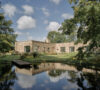
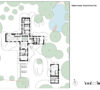
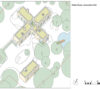
The inspiration for Hidden House came from the secluded mature garden plot, set back from the main central green of a small East Midlands village. Hidden away behind established housing, the large, peaceful space was divided into quadrants by patchy and unruly hedging, each area with its own distinct character; flat lawn, orchard, tree-shaded pond and planted beds. Rich with mature trees, established wildlife and native shrubs, the aim was to preserve the magic of the plot whilst creating a way to live in the midst of it. The cruciform plan serves to preserve and reinforce the uniqueness of the four distinct areas of the original garden, while connecting the interior directly to these outdoor spaces.
The house is designed as a calm backdrop to the daily routine of family life; a place to enjoy the movement of sunlight through the building and to sense the changing seasons beyond, from a tranquil and comforting home.
The site is a large garden plot, bounded by mature trees on all sides, inhabited by wildlife, including great crested newts, deer and woodpeckers. The challenge was to design a new home which would preserve and not dominate this attractive landscape. The brief was to create a family home that would accommodate changing family needs, with spaces for large gatherings as well as more intimate spaces for privacy and contemplation. The accommodation includes four bedrooms, a large family room, lounge, gym & study arranged around a central courtyard. There is also a separate studio garage building which is designed as a workspace with potential for use as additional family accommodation.
The cruciform plan arrangement gives each ‘wing’ its own character and particular outlook while allowing the house to be used in parts or as a whole. The placement of rooms follows the passage of the sun throughout the day with the bedrooms awaking to early morning light from the East while the living spaces benefit from the midday and evening sun.
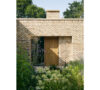
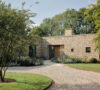
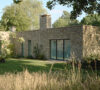
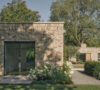
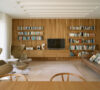
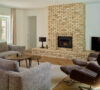
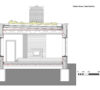
The house is an exploration of what it is possible to achieve using simple, traditional methods of construction and local craftsmen to create a low energy, sustainable home on a limited budget. A simple palette of materials including brick, stone and oak joinery was used throughout the building to give a robust, durable finish which will age attractively over time. The house is topped with brick chimneys and an extensive green roof planted with meadow grasses and flowers which provide an additional habitat for wildlife.
Following a ‘fabric first’ approach to sustainability by adopting passive design with high insulation levels, air tightness and triple glazing. This is supplemented with an air source heat pump, MVHR and on-site generation from an array of photovoltaic panels and battery storage.
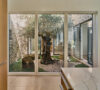
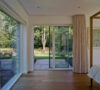
The glazed central courtyard features a mature olive tree and provides visible connection between the wings, sunlight to the heart of the plan and cross ventilation in warm weather.
The house, studio and landscape is fully accessible so that it can be experienced and enjoyed by family members with limited mobility and provide for future needs without adaptation.

The inspiration for Hidden House came from the secluded mature garden plot, set back from the main central green of a small East Midlands village. Hidden away behind established housing, the large, peaceful space was divided into quadrants by patchy and unruly hedging, each area with its own distinct character; flat lawn, orchard, tree-shaded pond and planted beds. Rich with mature trees, established wildlife and native shrubs, the aim was to preserve the magic of the plot whilst creating a way to live in the midst of it. The cruciform plan serves to preserve and reinforce the uniqueness of the four distinct areas of the original garden, while connecting the interior directly to these outdoor spaces.

The house is designed as a calm backdrop to the daily routine of family life; a place to enjoy the movement of sunlight through the building and to sense the changing seasons beyond, from a tranquil and comforting home.

The site is a large garden plot, bounded by mature trees on all sides, inhabited by wildlife, including great crested newts, deer and woodpeckers. The challenge was to design a new home which would preserve and not dominate this attractive landscape. The brief was to create a family home that would accommodate changing family needs, with spaces for large gatherings as well as more intimate spaces for privacy and contemplation. The accommodation includes four bedrooms, a large family room, lounge, gym & study arranged around a central courtyard. There is also a separate studio garage building which is designed as a workspace with potential for use as additional family accommodation.

The cruciform plan arrangement gives each ‘wing’ its own character and particular outlook while allowing the house to be used in parts or as a whole. The placement of rooms follows the passage of the sun throughout the day with the bedrooms awaking to early morning light from the East while the living spaces benefit from the midday and evening sun.

The house is an exploration of what it is possible to achieve using simple, traditional methods of construction and local craftsmen to create a low energy, sustainable home on a limited budget. A simple palette of materials including brick, stone and oak joinery was used throughout the building to give a robust, durable finish which will age attractively over time. The house is topped with brick chimneys and an extensive green roof planted with meadow grasses and flowers which provide an additional habitat for wildlife.

Following a ‘fabric first’ approach to sustainability by adopting passive design with high insulation levels, air tightness and triple glazing. This is supplemented with an air source heat pump, MVHR and on-site generation from an array of photovoltaic panels and battery storage.


The glazed central courtyard features a mature olive tree and provides visible connection between the wings, sunlight to the heart of the plan and cross ventilation in warm weather.


The house, studio and landscape is fully accessible so that it can be experienced and enjoyed by family members with limited mobility and provide for future needs without adaptation.